Tweaking Encounter Density Quick Guide
How fast and furious do you want it

Some recent play sessions and projects sent me down a rabbit hole on game pacing. Honestly, I seem to chase lots of rabbits. This is just the most recent one.
Let me start with a couple of questions…
When you play a randomized sandbox game or dungeon crawl, do you enjoy, or at least not mind having long stretches without any encounters or discoveries?
Or do you like it when the world seems full? A place where nearly every hex or room has monsters, traps, treasures, or NPCs?
These questions get to the heart of encounter density and directly affect the game's pacing. In the first scenario, your most intense battle will be with resource management. It’s a survival game. You’re constantly worried about running out of food, water, torches, fuel, or whatever the game rules track.
It’s a battle against weather, starvation, and navigation.
The second type of pace is extremely cinematic. Constant combat, NPC encounters, hazards and boons, discoveries, and the like. The focus becomes maintaining health or hit points, social interactions, avoiding nasty traps, and getting lots of loot.
Rations and weather take a back seat to weapons, armor, medical gear, and healing spells.
Honestly, I enjoy games that span both extremes, but it’s nice to have a way to speed things up or slow them down to suit your group or solo play session. Maybe you’ve thought of this before, maybe not.
Encounter/Feature/Event Probability
In a group game, some or all encounters are likely already keyed. This is especially true in dungeon crawls. However, wandering monsters/random encounters are usually a threat. Of course, some GMs enjoy the challenge of low-prep randomization or improv.
Most solo games are entirely randomly generated. There may be a few known locations on a map or a main boss somewhere deep in the ruins. Other than that, you’ll rely on the dice and tables.
In some systems, you roll only once for an event, then determine the type. Games like Cairn 2e use this method. Maybe this watch will be a monster, NPC, or complicating event, but there seems to be little downtime.
Other systems call for individual rolls for each type of event: encounters, points of interest, hazards, etc. It’s common in OSR-style systems like Kal Arath, Niv Lova, and Tome of the Pyromancer.
Some require only a single check per day, such as B/X D&D, while others require multiple rolls. Maybe daytime/nighttime rolls, or even multiple rolls per day and night, based on time intervals or watches. Cairn 2e uses a six-watch system. You’re checking every four hours of game time.
In my experience, the two primary methods of adjusting pace are the likelihood of an encounter on each roll and the number of rolls required. Should the game seem to be moving too quickly, I can change the number of rolls or the probability of an event.
Though I’m a believer in sticking to the rules, adjusting the pace sometimes improves the experience. It’s all based on the storyline and fiction.
I did a bit of math on these to help my own gaming and game design, so I thought I’d share the results. Results are rounded to the nearest tenth.
Common OSR (d6) Methods
1 on 1d6

16.7% chance per roll

Mean rolls before encounter: 6 ± 5.5
1-2 on 1d6
33.3% chance per roll
Mean rolls before encounter: 3 ± 2.51-3 on 1d6
50% chance per roll
Mean rolls before encounter: 2 ± 1.4A very simple tweak to make.
You can wander around for quite some time with a 1 in 6 chance, but a 3 in 6 chance will give you (possibly) more than you can handle. Older gaming modules typically reserved the highest probabilities for the most dangerous terrain or proximity to a lair or base.
I just chose the d6 because it’s so ubiquitous. You could replicate or approximate these percentages easily with other dice.
One point on a d6 is worth about 17% of the probability. So even a minor change will make an incredible difference in the game’s pace, even if you only roll once per day.
Multiple rolls in a single day really ramp up the encounter density. In the games I’ve played, encounters with a 1 or 2 in 6 chance seem to be popular, so I’ll focus on those.
Roll Day and Night
1 in 6 chance rolled for day and night

30.6% across both rolls

Mean rolls before the encounter: 3.3 ± 2.7
2 in 6 chance rolled for day and night
55.6% across both rolls
Mean rolls before the encounter: 1.8 ± 1.2Rolling multiple times per day means you won’t get very far before you encounter something. I’m not going to do all the math for a watch-based system. Needless to say, the world of Vald in Cairn 2e is dense. Very dense.
Not only do you roll multiple times each day, but using the rules-as-written in the Player’s Handbook, something will ALWAYS happen on a watch. The dice decide if it’s an encounter, discovery, weather event, or some complication, but there’s very little downtime.
Hopefully, I didn’t bore you to tears with the stats above. I’m not really a math geek, but statistics are interesting for the overview they provide.
Want to build or play a fast-paced game? Higher probabilities and more rolls. Like a slower grind that fits your theme? It’s not hard to pull off.
Of course, math can’t replace playtesting. Statistics and theory don’t always withstand the test of reality and subjective experience. TTRPGs live in a world of subjectivity, so the key is to come up with an idea and see how it feels at the table.
Just for a simple trial, I thought I’d roll up a single-encounter, single-POI for each day, with 1 in 6, 2 in 6, and 3 in 6 chances to see what I got. Results were a bit on the high side, but that’s just how randomness works.
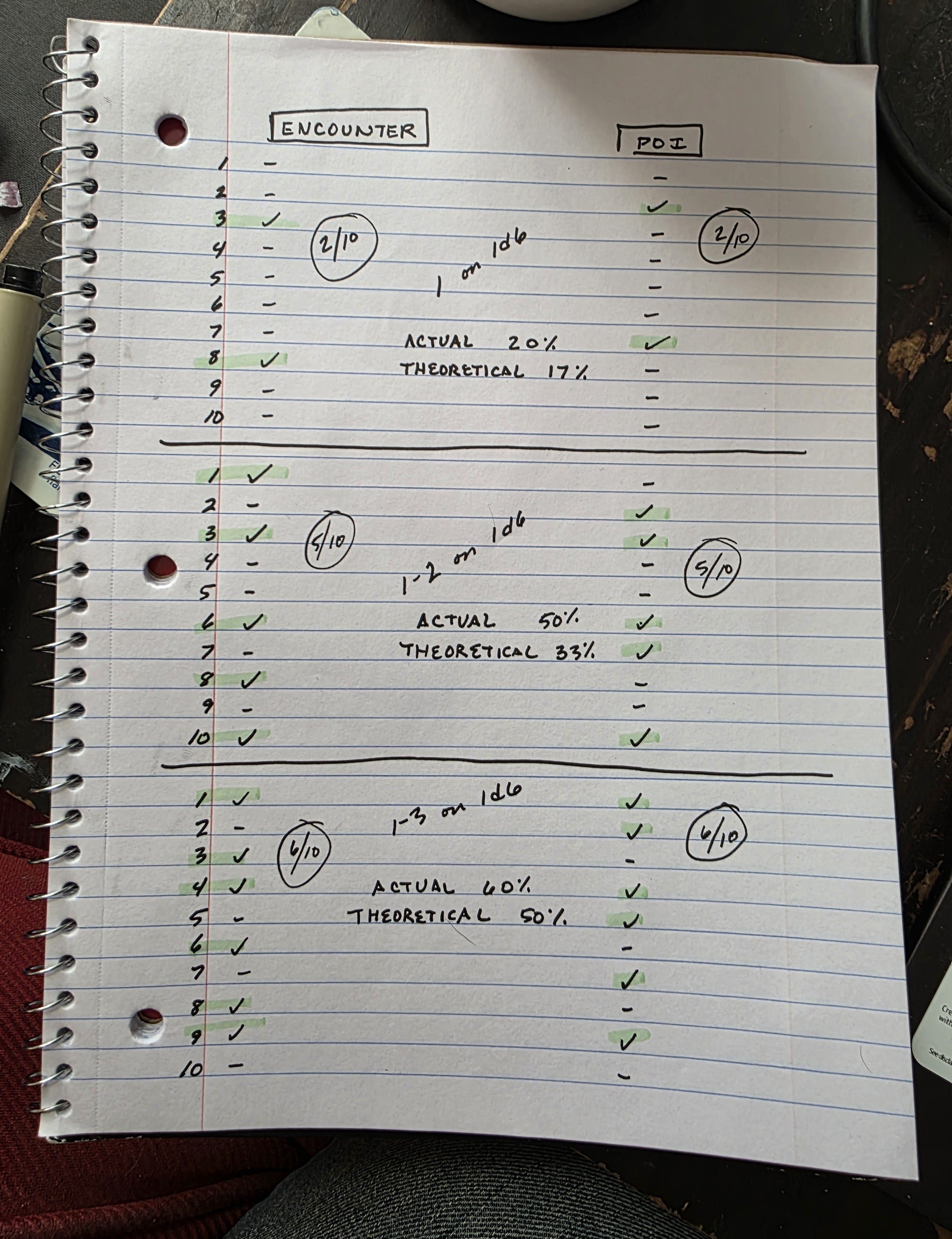
The percentages would even out over time, but assume each trial was a game session of 10 hexes, travel days, or whatever unit you use. A single point on a d6 would make a massive difference in how the session felt.
If you’re interested in these types of calculations, check out the following websites.
Anydice
Hope this helps!
Oh man, have I thought about this one a lot - without any firm conclusions. I'm now leaning towards always finding something - a boon, POI, Hazard, encounter, NPC.
I think switching up the odds by adding a slight change to the probability (+ or -) is a very good idea. I'm in favor of tweaking things a bit here and there - especially if it will enhance enjoyment of a session.
I recently discovered the 'underclock' as an alternative to the 1-6 chance encounter type of roll.
Perhaps that's something you're already familiar with.
The underclock starts at 20. Each time you make an encounter roll, roll 1D6 and substract from 20. When the underclock reaches 0, an encounter happens.
Players get a rough idea of when an encounter might happen and can plan accordingly. And you're sure an encounter will eventually happen (a 1 on a D6 roll might not happen for a long time, if you're (un)lucky).
Now to your density. If you want encounter to happen quickly, you could lower the 20 to a 15. Or roll a D8 or 2D6/A. Lower density? Start a clock at 30 or add events that reset the underclock.